







News Archive 2026 Jan-Mar
It was path maintenance again for the working party of twelve volunteers who turned out this morning at Hartley Lane carpark, plus some other repair jobs.
After our usual group discussion and instructions, we divided into two groups. The first went off upstream of the stone bridge to sort out a dog-slide. This was blocked off in the usual way.
Next they went to the side waterfall where the boardwalk needed repair. One of the wooden treads had broken, so this was replaced with a new one, and the anti-slip chicken-wire was repaired also.
Next the riverside fence near the dipping pond was mended in a couple of places – easily fixed with a couple of screws. This party then joined the others who had already done a lot of path restoration work.
We today restored the path from the carpark to the wicket gate, the one down to the dipping pond area and also the pond access path.
Photograph A. Restoring path
Photograph B. Result
Our lady chairperson came along at break time with some choccy biccies, which were enjoyed, along with the mince pies left over from Xmas.
We felt that we were getting lot of work done, aided by the fact that we had a good turnout today, but the drizzle slowly turned to rain, and it was becoming difficult to work in the muddy conditions. So, we trudged back to the carpark, cleaned our tools and stowed them in the van, and off home we went, having enjoyed some good exercise out of doors despite the infelicitous weather.
By the way, we spotted some snowdrops today – always a good sign.
Photograph C. Snowdrops in bud
By the way also, there was still a thick layer of ice on the pond – more than an inch depth – despite the thaw.
Note that the previous week’s session had to be cancelled again because of foul weather. Rain and snow have disrupted a record number of sessions this winter!


The working party was doing fence work and path work near the old railway embankment this morning – nine volunteers assembling at the parking bay near the Holywell water pumping station.
The fence work was another attempt to block off access to the mountain biking area from the path along the old railway line. Part of the fence beside the gate at the south end of the embankment had been kicked away, so an extra fence post was put in and cross-pieces put in place.
Photograph A. Mending fence
Photograph B. Mountain bike area
If this doesn’t stop all access by mountain bikers, perhaps it will discourage them by signalling that the damage they do is not welcome.
While three volunteers were doing this, the rest of the squad were installing some low steps in the path that slopes up from the riverbank path on the north side to the north end of the embankment. This slope is slippery on wet days and also when there is snow or ice on the surface. We hope that by placing some timbers across the path – which are not high enough to cause a trip hazard – we can improve the situation.
This job involved digging a shallow trench across the path, putting a length of timber in place, hammering in a couple of stakes alongside and the screwing the timber to them, filling around about with earth and dressing the path surface with gravel (aggregate, strictly speaking).
Photograph C. Installing steps
It was getting the gravel that was the difficult bit in that procedure, because the nearest reserve pile was a long way away: near the downstream wooden footbridge. Have you ever tried wheelbarrowing a heavy load of gravel along a muddy, undulating path? – tiring! Anyway, we reckon we improved the usability of the ramp path today.
Photograph A. Outcome
The weather was damp, cold and mostly cloudy, but the birdlife scene was a bit more lively than usual. A hint of spring? Anyway there were blue tits, great tits, robins and goldfinches flitting about in the trees and jackdaws were calling near our assembly place.
We’ll be back next week to make more improvements to the Dene, never fear!


Eight volunteers met at the Northumbrian Water pumping station on a cold and very windy morning to continue the path work from two weeks ago on the slope down from the wagonways to the burn (last week’s work being cancelled due to wind and heavy rain). Fortunately once at the work site we were out of the cold wind.
The first task was to dig a trench on the uphill side of the path and then install a pipe under and across the path to hopefully divert rainwater off the path and prevent the muddy and at times icy conditions.
Photograph A. Installing steps
Next, more steps were installed and topped up with gravel. This was a very onerous task as the nearest gravel pile is a long way from the work site and required multiple trips with heavy wheelbarrows. Hopefully next week when we continue we will have some gravel a bit nearer, watch this space.
Photograph B. Applying gravel
Wildlife was scarce this week but there were many walkers enjoying the dry but cold conditions.
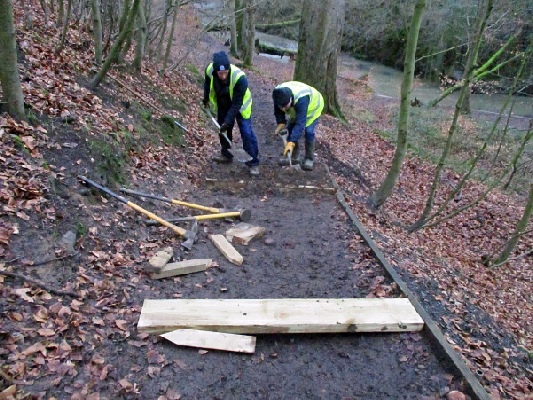

Eight eager volunteers turned out this morning at the water pumping station along Holwell Lane for another path-improvement session, on an overcast but generally dry day.
As last week, the main task was to install steps in the sloping path up from the riverside path to the northern end of the old railway embankment. We started off however by clearing out last week’s drainage trench and unbunging the associated plastic culvert pipe under the path.
That having been done, we started installing more steps. A number of these were installed in the path downhill from where we were working last week. Spades and mattocks were used to cut a slot in the earth for each step. A board was the placed in the slot and a couple of stakes hammered into the ground alongside. The board was secured to the stakes with screws, and the space around the board refilled with soil.
Photograph A. Installing steps
Next, the surface near the step was dressed with gravel for a better walking surface. As last week, getting the gravel to site was a time-consuming task but not, however, as bad as last time because we have had some gravel delivered to a place close to the pumping station which is much closer to the work site.
Photograph B. Laying gravel
The expected rain didn’t materialise but there was a bit of drizzle towards the end of the session. We didn’t quite get the job finished, but we’ll be back next week.
On the wildlife front, although there aren’t many signs of spring yet in the Dene, the bird life is looking up. We saw or heard a nuthatch, some robins, a goldcrest (last week actually), some greylag geese flying around, a song thrush, a dipper and various common small birds.
Watch this space for more news on improvements to the Dene.


The improvements to the tunnel ramp path are now complete, thanks to the efforts of the nine hardy volunteers who turned out for some exercise on this frosty but sunny morning at Holywell.
The meeting place was at the Northumbrian Water pumping station gate. After unloading the necessary tools and materials we set off for the path in question: the one that slopes up to the north end of the tunnel embankment from the riverside.
We had already spent three sessions installing steps on that path and improving the surface with gravel. Today was the fourth and last session on that project.
The main part of the work was putting in place edging boards on the downhill side of the path. This involved digging a shallow slot along the path edge with mattock or spade, then fitting a plank (of recycled timber) into the slot, then fastening in place with stakes and screws, then filling either side with soil.
Photograph A. Edging the path
Photograph B. Ditto
In addition to that activity, we continued the arduous job of wheelbarrowing gravel from the deposit near the pumping station to the ramp path and spreading it on the surface.
It was nice sunny day once it had warmed up after an early frosty start. The main wildlife interest was a robin, who came to pick up worms from the ground we had disturbed, and who did a bit of singing as well.
Our lady chairperson came along for a bit of a chat mid-session, as she often does. At the end of the session, we tidied things up, took our tools back to the van, cleaned them, loaded them up, and off we went.
The ramp path ought to be a lot less slippy in wet or frosty weather from now on. Enjoy!


Milder weather and a refreshingly different activity greeted the eight working-party volunteers who turned out this morning at Wallridge Drive, Holywell. It was back an old favourite: river blockage clearance.
Here’s the problem:
Photograph A. Logjam
As you can see, once you get a branch falling into the river, it isn’t long before a big backlog of twigs, branches, litter and scum build up.
So two of us put on waders, got into the river and got stuck into the job of dismantling the blockage. The others stood on the river bank, accepting the branches and other debris as it came out of the water and conveying it to the other side of the riverside path, away from future flood waters.
Photograph B. Dismantling logjam
Photograph C. Removing a branch
There were some big timbers in the logjam, and it soon became apparent that bowsaws were not enough to clear them – so the hand winch would have to be deployed.
Photograph D. Operating winch
We attached one winch to a nearby tree and ran the winch cable out to the logjam. The biggest log was massive which dug into the riverbank and refused to budge. It had to be hauled out using two winches.
By the end of the session we had cleared all of the debris apart from one rather large old willow which will just have to stay there for now
Photograph E. End result
Wildlife. One of us started the Merlin birdsong identification app on their mobile phone and forgot to turn it off until the end. The result was an incredible list of birds identified, including robin, blue tit, great tit, buzzard, great spotted woodpecker, mallard, etc. The bird world is starting to gear up for the nesting season!


The meeting-place for the working party this morning was outside the Milbourne Arms, Holywell. The squad numbered nine, of whom one was a new recruit – and a hearty welcome to him! The weather this morning was just right for volunteering work – overcast but mild and not windy or rainy.
The team leader has spotted a couple of river blockages near the Holywell road bridge. So, after loading up the wheelbarrows, off we went down to the old Holywell bridge and over to the south side, then along the downstream path to just before the first flight of steps.
At this point three of us put on waders and got into the river to dismantle the first logjam – caused by a riverside tree collapsing across the burn. The others stood on the river bank to receive branches etc as they came out of the water. They also sawed off some of the branches of the collapsed tree.
Photograph A. Fallen tree
As usual, there was quite a lot of plastic litter in amongst all the twigs and branches that had built up upstream of the tree. This was, as usual, collected up and bagged for disposal as general waste.
Photograph B. Clearing blockage 1
The hand winch had to be deployed to get some of the big timber out. This enabled us to remove many of the large branches after detaching them with bowsaws. Some of them however were too big, and remain resting in and above the water, so more work will be needed in future.
Photograph C. Result
About mid-session we finished off work on the first logjam, loaded up our wheelbarrows and trundled off to the second river-blockage, which was upstream of the Holywell bridge and at the place where a sewer pipe crosses over the burn, supported by a stone column in the middle of the river which has always tended to trap any large branches that drift downstream.
So the three of us with waders on got into the river again. Meanwhile the team on the bank set up two winches to drag out the huge branch that was causing the blockage as well as several lesser ones. Other, smaller, branches were simply thrown or heaved out – placing them as high as possible up the river bank to keep them above flood level.
Photograph D. Clearing blockage 2
Photograph E. Winching branch out of river
We managed to get all the wood out of the river by noon, so, since it was quite close to going-home time, we packed things up and went home, satisfied at having done two sessions’ worth of work in one session!
Oh by the way, there was some birdlife interest today:
- a cormorant – a big fish-eating bird normally seen at sea – was spotted near the second blockage
- a pair of mallard ducks were seen nearby
- songbirds included greenfinches, blue tits, coal tits, great tits and a wren


Willow-weaving was again the theme of this morning’s working group session at the gabions upstream of the stepping stones. Seven volunteers assembled close to Hartley West Farm on a grey but dry day.
The task today was to perform annual maintenance on the willows at the gabions. We thought we would do this job now because the forecast is that some wet weather is coming, which would be good for rooting in.
To remind you, we installed these gabions (wire cages of stones) and willows years ago to shore up the river bank where it was being eroded (partly by dogs). As usual, we loaded up our wheelbarrows with tools from the van and headed off up the path to the work site.
We then set about pruning the willows. These grow long, whippy stems every year. Loppers and bowsaws were used to cut these down to a reasonable height. Meanwhile, one of us put on waders and got into the river to prune the willows at water’s edge (and to remove litter, and to plant willows on the other bank).
Photograph A. Cutting willows
The cut stems were then used to construct a willow barrier to block off a doggie-slide. Some thicker stems were cut to a suitable length and pushed into the soil of the river bank. These verticals were then inter-woven with thinner willow wands to produce a basket-like effect.
Photograph B. Starting the weave
Photograph C. More weaving
Photograph D. Completed barrier
There were lots of walkers and runners out today, and quite a few of them stopped to comment (positively!) on our handiwork.
Here are some of the wildlife/birdlife highlights:
- daffodils in bloom in the meadow close to the stone bridge
- lots of noisy rooks in the rookery nearby, accompanied by jackdaws
- lots of chiffchaffs (insect-eating warblers from Africa) singing in the trees
- robins, wrens, blue tits, great tits singing
- goldfinches, woodpigeons and pheasant heard
We managed to get all this done a bit before the usual end of the session, so we packed up, returned to the van and returned to our homes. Shortly after that, it started raining – so, perfect timing!


It was willow-weaving near the estuary for this morning’s working party of nine volunteers. The meet-up point was Hartley Lane carpark and the weather (after some initial cloud) was warm and sunny!
We loaded up the wheelbarrows, as usual, with tools from our little red tools van and marched down the Dene to the seat upstream of the head of the estuary. In front of that seat is a stand of willow which we planted several years ago along the river bank to prevent dogs from rushing into the water and eroding the riverbank.
Photograph A. Stand of willow
These willows are common osiers (Salix viminalis) and they grow very rapidly, throwing up, in a year, long thin branches easily 10 feet long. These need to be pruned back every year and woven in to the other plants to form a barrier.
So, we got the loppers out and a long-handled pruner and started work. One of us got into the river with waders on to tackle the overhanging branches.
Photograph B. Willow pruning and weaving
The willow pruning and weaving proceeded well, and meanwhile we started to tackle a minor logjam somewhat upstream of the willows. A heavy waterlogged branch was partly block the stream, and after some bowsaw work a group of us pulled the branch out onto dry land.
While we were working in that area we noticed that the bank was being eroded by doggies thereabouts, so we pushed some of the cut willow stems into the earth in a line along the water’s edge and wove other stems into them horizontally to form a barrier.
Meanwhile the pruning and weaving of the original willow barrier proceeded to completion.
Photograph C. Willow barrier after maintenance
Finally, as we were walking back to the carpark, we did some tree pruning in the plantation on the east side of the path. Lower branches need to be removed from developing trees, e.g. oaks, to encourage them to push upwards.
- It was a good day for birdlife and we were using the Merlin app to identify birdsong. Seen and heard today were:
- the local flock of pink-footed geese
- at least five grey herons in the heronry
- chiffchaff, blue tit, great tit, chaffinch and wren all singing away
- a willow tit heard – a rare treat!
- pheasants, magpies, woodpigeons, carrion crows, rooks and herring gulls all seen and/or heard
- mallard and moorhen were spotted on or near the water
- a queen bumblebee was seen feeding on the nectar provided by the catkins and no doubt looking for a place to start a colony
Incidentally, a chiffchaff (a migratory insect-eating bird) was heard a week ago – the first of the year for us.


An eight-person working party assembled at the water pumping station east of Holywell this morning to do fence repairs and path repairs, and to give the Holywell side burn a good clear-out.
Three of the volunteers went to the kissing-gate off the old railway line that the youngsters use to access the mountain-biking area. Their job was to repair the nearby fence which has recently been vandalised by unknown individuals. Tools required were heavy-duty fence-post auger grabbers, a posthole digging spade, a drill, an impact driver and some screws.
Photograph A. Fence being repaired
First of all we had to decide where to dig the holes for the new posts. Three holes were required. These were soon dug out using the ratio of a third of the post in the ground and two thirds above.
One of the team filled a bucket with water from the burn for mixing postcrete for securing the posts. This was done by pouring some of the dry postcrete into the hole around a post, then carefully pouring water in, adding more water and postcrete until the post was secure. The hole was then backfilled with soil and tamped down.
Once the first post was secured we re-attached the old cross-rails using the drill for a pilot hole and the impact driver to secure the cross-rails to the new post. A total of three new posts were required to finish the job, which took an hour and a half; then we joined the other party of volunteers to help them finish their tasks.
Photograph B. Repaired fence
Meanwhile, upstream at the Holywell side burn the other five volunteers were clearing out the burn and mending a footpath step. The side burn was congested with branches, twigs and silt, and there was a danger that this material would block the two parallel culvert pipes that take the water under the footpath.
So, it was into the water in wellies to clear all the junk out of the stream with spades. This took quite a while to do, as there was a lot of debris to be shifted. Some litter was removed as well. A couple of logs had to be sawed in half to get them out. A small dam was dismantled also. By the end, the water was flowing nicely.
Photograph C. Clearing side burn
Meanwhile one of the timber steps in the flight leading up the slope to the west had to be replaced. It was dug out and a new one put in place, with stakes to secure it.
Photograph D. Replacing step
It was a chilly day because of the wind, but not so bad in the sheltered conditions of the Dene. We managed to get the work done before the allotted time, so were able to head homeward somewhat early, having completed three useful maintenance jobs.


Nine volunteers assembled at the Holywell water pumping station to clear a river blockage downstream of the tunnel. No photos were obtained, but here is a brief account of activities.
A logjam had built up over the winter behind the old fallen tree just down from the tunnel under the old railway line. As usual it was accompanied by litter and mess. Three of us put waders on and started to dismantle the logjam. We collected the plastic litter in the logjam and bagged it up for disposal.
Meanwhile other volunteers moved the extracted branches and twig litter to ground away from the water. The hand winch had to be deployed to get some of the larger logs out of the river.
A woodpecker was heard drumming this morning and the dipper (a water-bird) appeared in the river while we were having out refreshment break.
Watch this space for future adventures of the Friends of Holywell Dene working party.
| Flowers |
| Trees |
| Fauna |
| Flowers |
| Trees |
| Fauna |